
12 Best Games for Large Groups That Get People Talking
Thirty people arrive for a company event, a reunion, or a birthday celebration. Half know each other, a few are checking their phones, and someone has already asked, “So, what are we doing?” That is the moment the right activity earns its keep. The best games for large groups do more than fill time. They get people laughing, talking, collaborating, and just suspicious enough of their coworkers to have a great story afterward.
A great big-group game is not necessarily the loudest one. It is the one with a clear goal, low barriers to joining, and enough structure to keep the room from turning into 14 separate conversations. Whether you are planning an office outing, a family gathering, or a party with a packed guest list, these games can turn a crowd into a cast.
What Makes a Large-Group Game Work?
Before choosing a game, look at the room, the group, and the energy you want to create. A standing icebreaker may be perfect for 60 people at the beginning of a conference, while a seated mystery works better for a dinner party where guests can settle in and play a role.
The sweet spot is simple: rules that can be explained quickly, participation that does not require a stage-ready personality, and rounds or clues that give everyone a reason to stay involved. Avoid games that leave most of the group watching two people compete. Spectatorship has its place, but it is not team building.
For corporate groups, also consider how much friendly competition the room can handle. A little rivalry wakes people up. Too much can turn a lighthearted event into a quarterly performance review with snacks.
12 Best Games for Large Groups
1. Murder Mystery Dinner
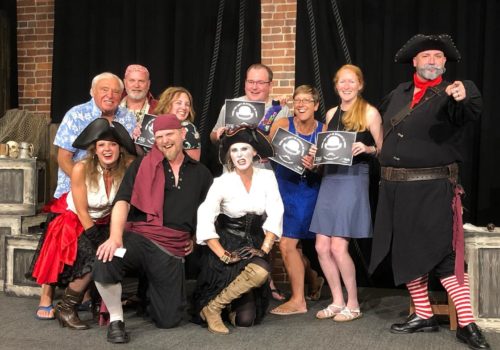
For a group that wants an experience rather than a quick diversion, a murder mystery is hard to beat. Guests receive characters, secrets, motives, and clues, then work the room to figure out who committed the crime. It gives natural conversation starters to people who have never met and lets confident personalities shine without requiring everyone to perform.
This works especially well for corporate celebrations, milestone birthdays, and holiday parties because it combines dinner, entertainment, and group interaction in one memorable event. A professionally hosted experience keeps the plot moving and ensures no clue gets lost in the bread basket. Mystery Cafe has spent decades proving that a little theatrical suspicion is excellent for group bonding.
2. Human Bingo
Human Bingo gets a large room mingling fast. Instead of numbers, each square contains a fact or experience, such as “has lived in three states,” “can play an instrument,” or “has watched the same TV show more than twice.” Guests find someone who matches each square and write down that person’s name.
Keep the prompts broad, fun, and workplace-appropriate. The goal is not to interrogate people about their deepest secrets before lunch. It is to uncover unexpected connections and make introductions feel easy.
3. Team Trivia With a Twist
Trivia is a reliable crowd-pleaser because teams can include both know-it-alls and people whose main contribution is remembering every 1990s one-hit wonder. The trick is building categories that give different kinds of knowledge a chance: pop culture, visual puzzles, local facts, music clips, absurd hypotheticals, and questions about the group itself.
For larger crowds, form teams of six to eight people and use a host or projected slides. Add a bonus round where teams must create a 10-second commercial, identify a mystery object, or solve a photo challenge. Those small twists keep the game from feeling like a test with better appetizers.
4. The Great Scavenger Hunt
A scavenger hunt gives a large group a mission and a reason to move. Teams can search a venue, neighborhood, office, or outdoor space for physical items, photo opportunities, riddles, and mini challenges. The best hunts mix speed with creativity, so the fastest team does not automatically win.
Make assignments clear and keep safety in mind. A downtown hunt may call for smaller teams and a time limit; an office hunt can include company history, hidden clues, and lighthearted challenges. Give points for completed tasks, originality, and teamwork, then announce winners with proper fanfare.
5. Two Truths and a Lie, Team Edition
The classic icebreaker gets stronger when people play in teams. Each team creates three statements about its members, two true and one false. Other teams guess the lie. It is quick, inexpensive, and surprisingly effective at making colleagues or relatives feel more human to one another.
This version works best early in an event, when people need a gentle nudge into conversation. Keep the pace brisk and invite stories after a particularly unbelievable truth. Someone has almost certainly wrestled an alligator, met a celebrity in an airport, or owned an alarming number of ferrets.
6. Minute-to-Win-It Challenges
Short, silly challenges are ideal when a group needs an energy reset. Think cup stacking, cookie balancing, paper airplane accuracy, or moving small objects with chopsticks. Set up stations, assign points, and let teams rotate through the challenges.
These games are inclusive when they favor coordination and problem-solving over athletic ability. They also work well in event spaces where you need entertainment that can run in a compact time window. Just choose materials that will not leave the venue looking like a craft store crime scene.
7. Name That Tune
Music is social glue, and Name That Tune can cross generations when the playlist is balanced. Play short clips and let teams identify the song, artist, decade, or missing lyric. Include a few obvious crowd favorites, but do not build the whole game around one person’s extremely specific yacht-rock expertise.
This is one of the best games for large groups at receptions, company parties, and casual gatherings because guests can join from their tables. A music round also pairs nicely with trivia or a longer hosted program.
8. Escape Room Relay
Traditional escape rooms can be difficult for groups of 30 or more because too many people end up hovering around the same lock. An escape room relay solves that problem. Divide participants into teams and give each one a series of puzzles, coded messages, physical challenges, or virtual clues to solve within a shared time limit.
The format rewards communication, delegation, and calm thinking under light pressure. It is especially useful for teams that want a purposeful activity without a lecture about collaboration. The puzzles do the teaching while everyone is busy trying to stop the imaginary disaster.
9. Werewolf or Mafia
Werewolf, sometimes called Mafia, turns a circle of guests into villagers, secret villains, and very dramatic amateur detectives. Players debate, accuse, defend themselves, and vote as they try to identify the hidden troublemakers before the game ends.
It is a strong choice for friend groups and social teams that are comfortable speaking up. It is less ideal for a quiet or newly assembled corporate group, where people may not want to make public accusations five minutes after exchanging business cards. Read the room before declaring anyone suspicious.
10. Giant Pictionary or Charades
Pictionary and charades are classics for a reason: they are easy to understand and funny even when no one is good at them. With a large group, teams take turns sending one player forward while the rest guess. Use a large pad, whiteboard, or projected display so everyone can see the action.
Customize prompts to the occasion. A company event can include industry terms and harmless inside jokes; a family event can use favorite movies, vacation memories, or famous relatives. Keep the categories varied so the same three people do not carry every round.
11. Photo Challenge
A photo challenge is part scavenger hunt, part creative competition. Give teams a list of images to capture: the best recreation of a movie poster, a team photo that tells a story, something in a specific color, or a shot that represents the event theme.
This game works well because guests naturally document events anyway. By giving the photos a purpose, you turn casual phone use into collaboration. Finish by showing a few submissions on screen and awarding prizes for creativity, commitment, and the most suspiciously convincing tableau.
12. The Question Game
For a low-prep option, put conversation prompts in a bowl and have teams answer or vote on them. Questions can be playful, such as “Which fictional workplace would be the worst to join?” or “What skill would be most useful during a zombie apocalypse?” They can also be tailored to a retreat, reunion, or shared interest.
The key is asking questions that invite personality without putting anyone on the spot. It is less about right answers and more about discovering who has an unexpectedly strong opinion about breakfast foods.
Match the Game to the Moment
If your group is meeting for the first time, choose something structured and low-risk, such as Human Bingo, team trivia, or a photo challenge. If the group already knows one another and wants a bigger shared memory, a murder mystery, escape room relay, or scavenger hunt gives them more to talk about afterward.
Virtual groups need a slightly different approach. Trivia, hosted mysteries, online escape games, and visual challenges translate well because they keep participants active on screen. Long explanation-heavy games do not. When people are joining from home, momentum is your accomplice.
Also consider your event timeline. A 10-minute icebreaker should not need a 20-minute rules briefing. A two-hour dinner program needs more narrative and variety than a single round of trivia. Good planning is not glamorous, but it prevents the real mystery: why everyone stopped participating.
The most successful group game leaves people with something better than a prize. It gives them a new inside joke, an unexpected connection, or a reason to say, “Remember when we solved that case?” Choose the format that fits your crowd, give it a confident host, and let the good kind of trouble begin.